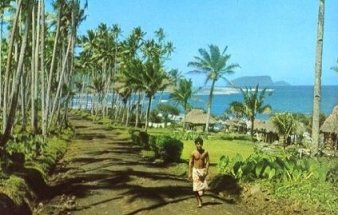
|
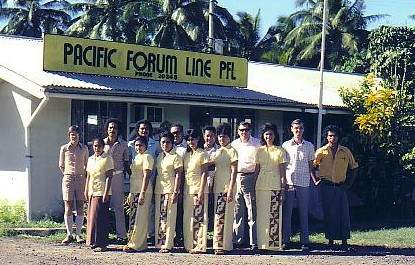
Western Samoa 1978 January 1978 to July 1978, Pacific Forum Line, Apia
Samoa is situated 13-14 S latitude and 171-172 W longitude. The
country comprises the two large islands of Upolu and Savaii, and
eight small islands only two of which are inhabited. The capital
Apia, and Faleolo International Airport are located on the island
of Upolu. The islands are volcanic and dominated by rugged
mountain ranges. Coral reefs surround much of the islands.
One person who made Apia famous was Aggie Grey - James Michener's 'Bloody Mary' of the South Pacific. Aggie is probably the best-known character in the South Pacific. She has even had a stamp issued bearing her portrait. She's had Pope Paul IV around for breakfast, partied with James Michener, and hobnobbed with stars like Gary Cooper and Marlon Brando, and anthropologist Margaret Mead. Three-star generals from the United States have stayed at 'Aggie's'. Aggie was born Agnes Genevieve Swann on 31 October 1897, and her father nicknamed her Aggie. He was a very stern Englishman from Surrey and never spared the rod. Aggie married Gordon Hay-McKenzie, the manager of the Union Steamship Company, after the First World War. The shipping company was taken away from a German firm when germany lost the war and their colony of Western Samoa. Her husband died, leaving her with four children and not much money. She started a nightclub, the Metropolitan, in the 1930s. After five years of widowhood she married again, one Charles Morton Grey. He too died, leaving her with another three children, and nothing in the bank, so she started another club. And that's how Aggie became famous. The American servicemen poured in and her fame spread. After the Second World War, Aggie decided to enlarge the club and turn it into a hotel.
:
:
|
 "Few men who come to the islands leave them; they grow grey where
they alighted; the palm shades and the trade-wind fans them till
they die, perhaps cherishing to the last the fancy of a visit home,
which is rarely made, more rarely enjoyed, and yet more rarely
repeated. No part of the world exerts the same attractive power
upon the visitor ..." So begins Chapter I of Robert Louis
Stevenson's "In the South Seas" and his name has been forever
linked with Samoa where he spent the last few years of his life and
where he died and was buried on the 3rd of December 1894 on Mt Vaea.
"Few men who come to the islands leave them; they grow grey where
they alighted; the palm shades and the trade-wind fans them till
they die, perhaps cherishing to the last the fancy of a visit home,
which is rarely made, more rarely enjoyed, and yet more rarely
repeated. No part of the world exerts the same attractive power
upon the visitor ..." So begins Chapter I of Robert Louis
Stevenson's "In the South Seas" and his name has been forever
linked with Samoa where he spent the last few years of his life and
where he died and was buried on the 3rd of December 1894 on Mt Vaea.
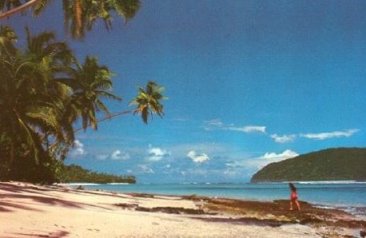 They tell me that McDonald's and television have come to Samoa since
I was there last when contentment on the island appeared to reign supreme.
But I believe the people have resisted the economic temptation of
increased industrialisation and still turn a healthy and happy face upon
the rest of the world.
They tell me that McDonald's and television have come to Samoa since
I was there last when contentment on the island appeared to reign supreme.
But I believe the people have resisted the economic temptation of
increased industrialisation and still turn a healthy and happy face upon
the rest of the world.

 Samoa experiences hot humid conditions most of the year. The average
temperatures range between 21 C - 32 C, with warmer months coinciding
with the wet season from December to April. Year-round humidity
averages 80%. The country is prone to cyclones during November to April.
The country's population is just over 161,000. Apia's population is about
34,000.
Samoa experiences hot humid conditions most of the year. The average
temperatures range between 21 C - 32 C, with warmer months coinciding
with the wet season from December to April. Year-round humidity
averages 80%. The country is prone to cyclones during November to April.
The country's population is just over 161,000. Apia's population is about
34,000.