|
Burma 1975 TOTAL-CFP, Rangoon
I flew out to Hong Kong where the company had booked me into the swank PENINSULA Hotel. In keeping with the hotel's reputation as one of the "swankiest" hostelries in the world, they met me at the airport with a chauffeur-driven Rolls-Royce. I hadn't expected this nor had they expected to meet a young chap straight out of New Guinea, in shorts and tee-shirt, carrying a swag over his shoulder. I just stayed long enough in "Honkers" to collect my Burmese visa before boarding a flight of the Union of Burma Airways. (UBA, as I was to find out later, was popularly known in the expatriate community of Rangoon as "Useless Bloody Airways"). Burma provided my first taste of living under a totalitarian regime. General Ne Win had seized power in 1962 and ruled the country like any dictator. He was known to fly into a rage if his orders were not carried out or were misunderstood. The government's policy was enshrined in a document known as the Burmese Way to Socialism, which had overtones of xenophobia. It embraced the jargon and outward manifestations of communism, but was uniquely Burmese and isolationist. Foreign investment was discouraged; and economically Ne Win sought to develop Burma by relying entirely on its own resources. The economy was soon in tatters, but the President refused to review his policies. Naturally, most businesses were nationalised. The black market did a thriving trade nd Rangoon's once famous business area had taken on the appearance of a ghost town. The Hongkong and Shanghai Banking Corporation became People's Bank 5/9. Retail stores, known as People's Stores, were also identified by number, and opened for business only when goods were available. The population would join queues forming outside these shops out of sheer habit or inquisitiveness, purchasing whatever was available if they could afford to do so. Items not required were used for barter or sale on the black market at inflated prices. However, Burma's ills were not entirely Ne Win's doing. Far from it. Ne Win had inherited chronic internal strife mainly due to ethnic problems. Put simply, the Union of Burma comprised the central Irrawaddy valley and delta, inhabited by Burmans, the traditional rulers of Burma. They were virtually surrounded on three sides by quite separate tribal groupings, such as the Karens, Shans, Chins, Mons, Kachins, and Arakanese, most of whom sought some form of autonomy from the central government in Rangoon, some by active hostility to the point of armed insurrection. Just how divided and underdeveloped the country is can be seen on any map: the Irrawaddy River flows some 2160 km from the Katchin Hills in the north to the Andaman Sea and the Bay of Bengal in the south and literally cuts the country in two halves, and yet, the Ava Bridge near Mandalay is the only bridge over it. During my time there it was said that the central government in Rangoon controlled some fifty percent of Burma by day but only ten percent by night. Despite all this, Burma was also a land of great beauty and it was a pity that it had been virtually closed to visitors for so long. While I was there, the overland routes from India and Thailand were closed and tourists were limited to 24-hour visas. The beach resort of Sandoway on the Arakan coast was a tropical paradise. The hill stations were also attractive in their own way. Towns such as Prome and Pegu were fascinating. Bassein on the Irrawaddy Delta in the heart of Burma's ricelands and the country's second biggest port, had the exotic atmosphere of a Joseph Conrad novel.
Judging by the repressive crackdown of the popular democratic movement in Burma during 1989, life there seems to have changed little over the past two decades. The name of the country has been changed to Myanma and the government is now a military junta; otherwise the Burmese Way seems to continue. It is a tragedy that the Burmese, or Myanmas if that is what they are now called, go on torturing themselves. I retain a soft spot for the Burmese and Burma, and I look back on my sojourn in Rangoon with a mixture of joy and sadness. I can still hear the tinkling of pagoda bells in the soft evening breeze and see the glorious majesty of the Burmese sunset in the Rangoon sky. With magnificent displays like those I wondered why Kipling had chosen to describe the dawn in his poem about "the road to Mandalay, where the flyin'-fishes play".
|
 I didn't even attend an interview for my next position as Chief Accountant
with the French oil company TOTAL: I answered an advertisement in the
FINANCIAL REVIEW while still in Papua new Guinea and in reply received an
airticket to fly direct to Rangoon and start work.
I didn't even attend an interview for my next position as Chief Accountant
with the French oil company TOTAL: I answered an advertisement in the
FINANCIAL REVIEW while still in Papua new Guinea and in reply received an
airticket to fly direct to Rangoon and start work.
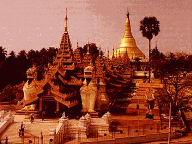 Rangoon itself was enchanting. Situated about 30 kilometres from the sea on the Rangoon
or Hlaing River, it was planned and built by the British after Burma's annexation in
the 19th century. In its prime, Rangoon was a holiday and shopping centre for the Asian
region and one of the busiest posts in the East, accommodating ocean-going vessels of up
to 12,000 tonnes. Rangoon's famous Shwedagon Pagoda was one of the finest in Asia and
regarded as one of the wonders of the world.
Rangoon itself was enchanting. Situated about 30 kilometres from the sea on the Rangoon
or Hlaing River, it was planned and built by the British after Burma's annexation in
the 19th century. In its prime, Rangoon was a holiday and shopping centre for the Asian
region and one of the busiest posts in the East, accommodating ocean-going vessels of up
to 12,000 tonnes. Rangoon's famous Shwedagon Pagoda was one of the finest in Asia and
regarded as one of the wonders of the world.
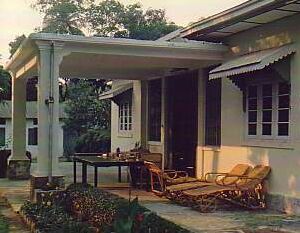
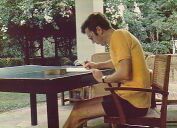 For the first few months I lived in the Russian-built monster of a hotel on the shores
of Inya Lake, just minutes out of town. Later I moved into an old stately home near
the Royal Lakes in Komin Kochin Avenue. My office was in U Wisara Road.
For the first few months I lived in the Russian-built monster of a hotel on the shores
of Inya Lake, just minutes out of town. Later I moved into an old stately home near
the Royal Lakes in Komin Kochin Avenue. My office was in U Wisara Road.

