South-West Africa 1968-1969
September 1968 to March 1969, Metje & Ziegler, Lüderitz
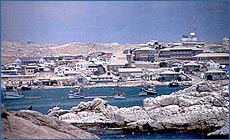
 South West Africa, or Namibia as it is called now,
stretches north from
South Africa's Orange River along 1280 kilometres of the loneliest,
yet in parts most hauntingly beautiful coastlines touched by the
Atlantic Ocean. The Namib desert, whose desolate sands have trapped
and killed thousands of men and women of every race as they sought to
unlock its secrets or merely to survive, runs right to the sea.
The local Ovambo people call Namibia "the land
God made in anger" and as the sun mercilessly bakes deserts,
plains and mountains alike, it is a close cousin to hell.
South West Africa, or Namibia as it is called now,
stretches north from
South Africa's Orange River along 1280 kilometres of the loneliest,
yet in parts most hauntingly beautiful coastlines touched by the
Atlantic Ocean. The Namib desert, whose desolate sands have trapped
and killed thousands of men and women of every race as they sought to
unlock its secrets or merely to survive, runs right to the sea.
The local Ovambo people call Namibia "the land
God made in anger" and as the sun mercilessly bakes deserts,
plains and mountains alike, it is a close cousin to hell.
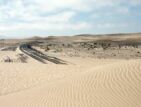 I flew into Windhoek and spent a few days at the "Head Office"
of
Metje & Ziegler
before boarding the overnight train for the 11-hour trip to Lüderitz.
The landscape was desolate! Occasionally, throughout the night the
train would stop and natives would climb down from the locomotive
with brooms and shovels to clear wandering sand dunes from the track.
www.natron.net/bilder/tourist has some
beautiful pictures of the country's scenery.
I spent
six months in
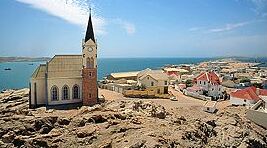
Lüderitz, which has a very interesting
history,
where I worked as a book-keeper for Metje & Ziegler Ltd.
to earn the necessary money for a passage
from Cape Town back to Australia.
I flew into Windhoek and spent a few days at the "Head Office"
of
Metje & Ziegler
before boarding the overnight train for the 11-hour trip to Lüderitz.
The landscape was desolate! Occasionally, throughout the night the
train would stop and natives would climb down from the locomotive
with brooms and shovels to clear wandering sand dunes from the track.
www.natron.net/bilder/tourist has some
beautiful pictures of the country's scenery.
I spent
six months in
Lüderitz, which has a very interesting
history,
where I worked as a book-keeper for Metje & Ziegler Ltd.
to earn the necessary money for a passage
from Cape Town back to Australia.
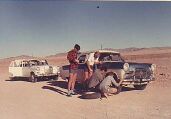
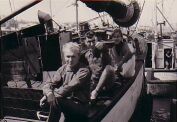 Lüderitz was a very German town and German was spoken as much as Afrikaans
(with a bit of English by those who were neither Germans nor Afrikaners). I
bought myself an "Afrikaans-Duitse en Duits-Afrikaanse Woordeboek"
for Rand 1.75 but never had to use it as everyone at work understood,
if not spoke, German. I shared
a flat in a company-house with Karl-Heinz Herzberg, another young German who
had emigrated to South Africa some years before and, after a time in Johannesburg where he worked
underground in a goldmine, had come to South West Africa. He was a kind and
generous friend whom I remember with great fondness and with whom I have maintained
a contact to this day. (As it turned out,
Karl-Heinz would never leave South West Africa: in 1972 he married the
daughter of a German farmer and ever since has been running their family farm near
Helmeringhausen in the interior of the country.
I have no pictures of his farm but nearby is the
Dabis Guest Farm which gives
me some idea of the area.)
Lüderitz was a very German town and German was spoken as much as Afrikaans
(with a bit of English by those who were neither Germans nor Afrikaners). I
bought myself an "Afrikaans-Duitse en Duits-Afrikaanse Woordeboek"
for Rand 1.75 but never had to use it as everyone at work understood,
if not spoke, German. I shared
a flat in a company-house with Karl-Heinz Herzberg, another young German who
had emigrated to South Africa some years before and, after a time in Johannesburg where he worked
underground in a goldmine, had come to South West Africa. He was a kind and
generous friend whom I remember with great fondness and with whom I have maintained
a contact to this day. (As it turned out,
Karl-Heinz would never leave South West Africa: in 1972 he married the
daughter of a German farmer and ever since has been running their family farm near
Helmeringhausen in the interior of the country.
I have no pictures of his farm but nearby is the
Dabis Guest Farm which gives
me some idea of the area.)
 The "kantoor" in which I had to spend my entire day was straight out of Dickens:
dusty, old-fashioned, and run by an Afrikaner woman by the name of "Mevrou Russo"
who "commandeered" two other Afrikaner women who treated the blacks,
referred to as "die goed" [these things], abominably. They must have been lying
awake at night worrying about the "swart gevaar" [the black danger].
What their jobs were never became clear to me.
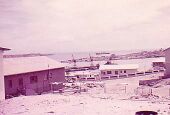
Then there were three German men who had something to do with the fuel storage down by the
harbour and the
hardware store behind the office. The whole lot was presided over by a thin and ageing man
not very flatteringly referred to as "Lügen-Müller". My own work was simple and
undemanding: keeping a mechanised debtors ledger (on a ledger-machine straight out of the Ark),
reconciling several bank accounts, and other bits and pieces around the office. It was a completely
dead-end job!
The "kantoor" in which I had to spend my entire day was straight out of Dickens:
dusty, old-fashioned, and run by an Afrikaner woman by the name of "Mevrou Russo"
who "commandeered" two other Afrikaner women who treated the blacks,
referred to as "die goed" [these things], abominably. They must have been lying
awake at night worrying about the "swart gevaar" [the black danger].
What their jobs were never became clear to me.
Then there were three German men who had something to do with the fuel storage down by the
harbour and the
hardware store behind the office. The whole lot was presided over by a thin and ageing man
not very flatteringly referred to as "Lügen-Müller". My own work was simple and
undemanding: keeping a mechanised debtors ledger (on a ledger-machine straight out of the Ark),
reconciling several bank accounts, and other bits and pieces around the office. It was a completely
dead-end job!
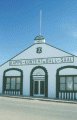 There wasn't much to do outside
working hours either: the occasional "braaisvleis" (barbecue), "kegelspeel"
(more beer than skittles) at Kapps Hotel on a Friday night, and a weekly visit to the
local "bioskoop" (picture theatre).
There wasn't much to do outside
working hours either: the occasional "braaisvleis" (barbecue), "kegelspeel"
(more beer than skittles) at Kapps Hotel on a Friday night, and a weekly visit to the
local "bioskoop" (picture theatre).
 It was at the "bioskoop" that I watched in full colour the
world's first heart transplant performed by a
Dr. Christiaan Bernard at the Groote Shuur Hospital
in Cape Town on 3 December 1967. Not that I remember much about it as I promptly fainted! However,
my memories of South West Africa and Lüderitz are forever linked with the music
of Miriam Makeba ("
The Click Song - Qongqothwane") and Marianne Faithful ("This is the evening
of the day, I sit and watch the children play, smiling faces I can see ..") which my
flat-mate Karl-Heinz played again and again on
his record-player. Even though located on the Atlantic coast in Southern Africa,
the cold
Benguela Current
turned swimming at Lüderitz into a rather masochistic activity as the ocean temperature rarely
rises above 12 degrees Centigrade.
It was at the "bioskoop" that I watched in full colour the
world's first heart transplant performed by a
Dr. Christiaan Bernard at the Groote Shuur Hospital
in Cape Town on 3 December 1967. Not that I remember much about it as I promptly fainted! However,
my memories of South West Africa and Lüderitz are forever linked with the music
of Miriam Makeba ("
The Click Song - Qongqothwane") and Marianne Faithful ("This is the evening
of the day, I sit and watch the children play, smiling faces I can see ..") which my
flat-mate Karl-Heinz played again and again on
his record-player. Even though located on the Atlantic coast in Southern Africa,
the cold
Benguela Current
turned swimming at Lüderitz into a rather masochistic activity as the ocean temperature rarely
rises above 12 degrees Centigrade.
Lüderitz is surrounded by the vast "Sperrgebiet" a 'no-go' diamond-mining area
controlled by Consolidated Diamond Mines, or CDM as it was generally known, who created their
own town
Oranjemund
at the mouth of the Orange River for the ten thousand or so Ovambos
(the black people of the area) and thousand whites employed there. There was a time when diamonds were
found simply lying on the beach and an anthropologist, Dr M.W.D.Jeffreys, believed this to have
been the coast referred to in the tale in A Thousand and One Nights which tells of a
beach strewn with jewels. The story of the discovery of diamonds by the German railway worker
August Stauch
and the rise and fall of the nearby town of Kolmanskop are described on
this interesting website.
 Six months in Lüderitz seemed a long enough servitude but the company didn't quite
see it the same way as they insisted that I repay them the inward airfares before they
allowed me to leave. I squared my account with them which left me with just enough money
for my sea passage back to Australia and the flight down to Cape Town. I liked Cape Town.
South Africa's Mother City was seductive: although a big town (at last count
2.86 million in the metropolitan area alone), local people seemed not only to be on permanent
vacation, but also proud of it ("You know why they call it the Mother City?" goes the wisecrack.
"Because everything takes nine months to get done."). Then there is the dramatic
backdrop of Table Mountain (named by Jan van Riebeeck on 6 April 1652)
which is the very reason for Cape Town's existence as European explorers
stopped and rested here in the early 1500s to restock their water supplies from a freshwater
stream spawned near the top of the mountain. Early Dutch sailors were so delighted to drop
anchor there that they rewarded the first seaman to sight the mountain with 10 guilders and a jug
of wine.
Six months in Lüderitz seemed a long enough servitude but the company didn't quite
see it the same way as they insisted that I repay them the inward airfares before they
allowed me to leave. I squared my account with them which left me with just enough money
for my sea passage back to Australia and the flight down to Cape Town. I liked Cape Town.
South Africa's Mother City was seductive: although a big town (at last count
2.86 million in the metropolitan area alone), local people seemed not only to be on permanent
vacation, but also proud of it ("You know why they call it the Mother City?" goes the wisecrack.
"Because everything takes nine months to get done."). Then there is the dramatic
backdrop of Table Mountain (named by Jan van Riebeeck on 6 April 1652)
which is the very reason for Cape Town's existence as European explorers
stopped and rested here in the early 1500s to restock their water supplies from a freshwater
stream spawned near the top of the mountain. Early Dutch sailors were so delighted to drop
anchor there that they rewarded the first seaman to sight the mountain with 10 guilders and a jug
of wine.
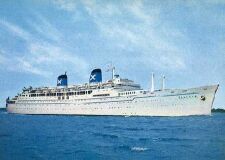 I sampled the delights of
Cape Town for a couple of weeks, hitched a vertiginous ride on the
barrel-shaped cable car to Table Mountain's peak, and watched the ships come and go in Table Bay
but although I was given the chance to join the local VOLKSKAS Bank, my mind was made
up to return to Australia and from there to try and get to New Guinea. So, eventually,
I boarded CHANDRIS LINE's "Ellinis", destination Sydney/Australia.
I sampled the delights of
Cape Town for a couple of weeks, hitched a vertiginous ride on the
barrel-shaped cable car to Table Mountain's peak, and watched the ships come and go in Table Bay
but although I was given the chance to join the local VOLKSKAS Bank, my mind was made
up to return to Australia and from there to try and get to New Guinea. So, eventually,
I boarded CHANDRIS LINE's "Ellinis", destination Sydney/Australia.
 Recently, I bought the DVDs
The Gods Must Be Crazy and
The Gods Must Be Crazy II
(German title:
"Die Götter müssen verrückt sein").
My travelling days are long over and I now live quietly at
"Riverbend"
on the South Coast of New South Wales in Australia but whenever I want to
relive some of my memories of South West Africa, I watch one of these movies.
A
review of these films also makes interesting reading.
Even though shot in neighbouring Botswana, the scenery in these films is very reminiscent of
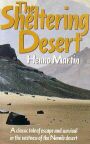
South West Africa. I also discovered a book in a second-hand bookshop,
The Sheltering Desert
(German title:
"Wenn es Krieg gibt, geh'n wir
in die Wüste") which is set in the Namib Desert
in the area around
Naukluft. The
Namibiana Bookdepot
sells this book, both in German and in English, as well as a
video recording
which was once shown on German television.
Recently, I bought the DVDs
The Gods Must Be Crazy and
The Gods Must Be Crazy II
(German title:
"Die Götter müssen verrückt sein").
My travelling days are long over and I now live quietly at
"Riverbend"
on the South Coast of New South Wales in Australia but whenever I want to
relive some of my memories of South West Africa, I watch one of these movies.
A
review of these films also makes interesting reading.
Even though shot in neighbouring Botswana, the scenery in these films is very reminiscent of
South West Africa. I also discovered a book in a second-hand bookshop,
The Sheltering Desert
(German title:
"Wenn es Krieg gibt, geh'n wir
in die Wüste") which is set in the Namib Desert
in the area around
Naukluft. The
Namibiana Bookdepot
sells this book, both in German and in English, as well as a
video recording
which was once shown on German television.

