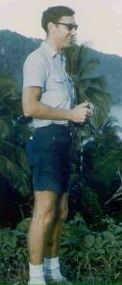
 Perhaps it is the result of having read Coral Island
and Somerset Maugham at an impressionable age, but the South Pacific
islands have always evoked a powerfully romantic image with me.
Mention the South Seas and I conjure up a vision of waving
coconut palms and a dusky maiden strumming her ukelele. Silhouetted
against the setting sun, Trader Pete (that's me!) sits in a deck-chair
in front of his hut sipping a long gin and tonic while a steamboat
chugs into the lagoon, bringing mail from home.
Perhaps it is the result of having read Coral Island
and Somerset Maugham at an impressionable age, but the South Pacific
islands have always evoked a powerfully romantic image with me.
Mention the South Seas and I conjure up a vision of waving
coconut palms and a dusky maiden strumming her ukelele. Silhouetted
against the setting sun, Trader Pete (that's me!) sits in a deck-chair
in front of his hut sipping a long gin and tonic while a steamboat
chugs into the lagoon, bringing mail from home.
In truth, I came to the then Territory of Papua & New Guinea as an audit clerk
with a firm of Chartered Accountants in Rabaul (and thereby hangs another tale).
 When the local newspaper,
the POST-COURIER, began carrying ads for audit personnel on the
Bougainville Copper Project, I applied and was invited to fly across
for an interview in October 1970. In those early days, all incoming traffic stopped
at the transit camp at Kobuan where one had to wait for transport to
Panguna where Bechtel's "top brass" had their offices.
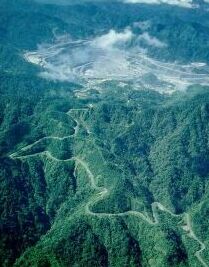
The road to Panguna was still something of an
adventure and it was some time before I could present myself to Sid
Lhotka, Bechtel's Manager of Administrative Services. He hired me on
the spot and I returned to Rabaul to give notice and get my things and
within a few weeks I was back "up top" only to be told that I would be
working at Loloho, senior auditor in charge of several large contracts
such as the construction of the harbour facilities (built by Hornibrook),
the Power House construction (built by World Services), the Arawa
Township (built by Morobe-ANG), and the haulage services (provided by
Brambles-Kennellys.) Des Hudson and a string of
time-keepers, amongst them Neil Jackson ("Jacko"),
Bob Green, and "Beau" Players joined the
team later.
When the local newspaper,
the POST-COURIER, began carrying ads for audit personnel on the
Bougainville Copper Project, I applied and was invited to fly across
for an interview in October 1970. In those early days, all incoming traffic stopped
at the transit camp at Kobuan where one had to wait for transport to
Panguna where Bechtel's "top brass" had their offices.
The road to Panguna was still something of an
adventure and it was some time before I could present myself to Sid
Lhotka, Bechtel's Manager of Administrative Services. He hired me on
the spot and I returned to Rabaul to give notice and get my things and
within a few weeks I was back "up top" only to be told that I would be
working at Loloho, senior auditor in charge of several large contracts
such as the construction of the harbour facilities (built by Hornibrook),
the Power House construction (built by World Services), the Arawa
Township (built by Morobe-ANG), and the haulage services (provided by
Brambles-Kennellys.) Des Hudson and a string of
time-keepers, amongst them Neil Jackson ("Jacko"),
Bob Green, and "Beau" Players joined the
team later.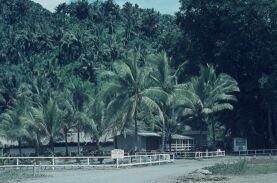
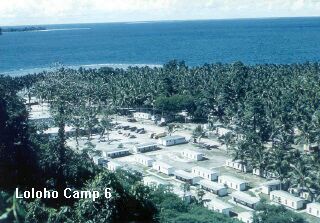
We all lived in Camp Six which was idyllically situated
on Loloho Beach. Every day (and often even before going to work), we would
go for a swim in the beautifully warm and clear waters of Loloho Bay.
Except for one: Bill Avery, our telephone operator who
was ex-Navy and claimed he had a pact with the sharks: they wouldn't come
onto his land, and he wouldn't go into their water. I'll never forget the
day when we had a prolonged power failure and no running water in camp,
and the whole camp population washed and shaved in the surf! Ever since I've been
keeping a cake of soap which lathers in seawater. The camp
had a certain hierarchy with "oldtimers" occupying
the front row of dongas facing the beach, also known as "Millionaires' Row."
Twice a week was film night to which viewers brought
their own plastic chairs and victuals and liquid supplies and watched
whatever was being offered (the
Natives were crazy about Cowboy movies), against a
backdrop of stars twinkling through swaying palm fronds and with the surf
as background music. Payday was the big night in Camp Six with
gambling tables such as Snakes & Ladders doing a roaring trade.
Flick shows (with little to be seen across the tops of a dozen boisterous
guys, all drinking and smoking, crammed into a 6-by-10ft donga) were
also highly sought-after.
The "boozer" (or Wet Canteen in the official
language), set right on the beach of Loloho, was a great place for
an evening out! Offshore, across the dark waters, several small islets marked
the outer limits of the reef. We named them "Number One Island", "Number
Two Island", and so on. On some night, after a sufficiently
large intake of SP (also known as 'Swamp Piss'), heated debates would
develop as to whether they were ships coming into port!
Sometime in 1971 I transferred to Panguna where I was put
in charge of the General Accounts Department with Brian Herde
doing the Accounts Payable and Gaskill keeping
the General Ledger. Neil Jackson somehow found his
way "up top" as well and became offsider to Brian Herde,
imitating one of the Three Musketeers by attacking all passers-by with
a long wooden ruler
until the day the booze got the better of him and he didn't turn up for
work at all. Sid Lhotka visited him in his donga at Camp 3 and rumour has it
that "Jacko" told him to f%@# off! He was on the next plane out!
 Another auditor wasn't quite
so outspoken to get off the island but did so even more quickly: Frank Joslin was
given the monthly "perk" of hand-carrying a batch of punch cards to Bechtel's Melbourne
office where he presented himself, never to be seen again thereafter.
His neat little trick became known as "doing a Joslin" and was much talked
about but never imitated. Some of the new recruits to the audit team
were less than delighted with their posting to muddy and rain-soaked
Panguna and started counting the days to the end of their twelve-month
contract - literally! They ran up an adding-machine strip list from
365 days down to zero and pasted it to the office wall, ticking off one
day at a time. Needless to say, not many survived that
kind of mental torture. There were some others who never left Aropa
airstrip: they had seen the mountain range shrouded in
clouds from the aircraft and, refusing to leave the small airline building
and spending a fretful night on a hard wooden bench, reboarded the same aircraft
for its morning flight back to Port Moresby.
Another auditor wasn't quite
so outspoken to get off the island but did so even more quickly: Frank Joslin was
given the monthly "perk" of hand-carrying a batch of punch cards to Bechtel's Melbourne
office where he presented himself, never to be seen again thereafter.
His neat little trick became known as "doing a Joslin" and was much talked
about but never imitated. Some of the new recruits to the audit team
were less than delighted with their posting to muddy and rain-soaked
Panguna and started counting the days to the end of their twelve-month
contract - literally! They ran up an adding-machine strip list from
365 days down to zero and pasted it to the office wall, ticking off one
day at a time. Needless to say, not many survived that
kind of mental torture. There were some others who never left Aropa
airstrip: they had seen the mountain range shrouded in
clouds from the aircraft and, refusing to leave the small airline building
and spending a fretful night on a hard wooden bench, reboarded the same aircraft
for its morning flight back to Port Moresby.
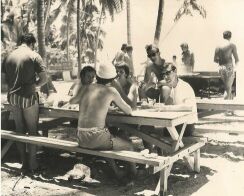 Others took to the wild camp life with gusto,
spending what little time was left after a 10-hour working day, in the "boozer"
and even investing in their own 'fridges outside their dongas. The nights
were punctuated by the squeaking of 'fridge door hinges and the squishing
sound of rings pulled off beer cans. A common "status
symbol" amongst serious drinkers were door-frame curtains constructed
from the hundreds of pull-top rings collected from empty beer cans. Les Feeney
was put in charge of the audit group but more often than not
was in charge of the carousing going on in the "boozer" and endlessly
stuffing his pipe but never succeeding in lighting it. He and
Peter the "Eskimo", a lumbering polar bear of a man hailing
from Iceland, ran a constant "throat-to-throat" race as to who was the biggest
drinker. "Bulldog", a likeable Pom, tried
hard to catch up with them! On one occasion he also tried to learn
how to play the electric organ. He never did but the speakers and
amplifier which came with it, were put to good (and all-too-frequent)
use when he played his favourite Neil Diamond record, "Hot August
Night." The whole camp rocked when "Bulldog" plugged in that organ!
I shall always associate "Hot August Night"
with nights at Camp One!
Others took to the wild camp life with gusto,
spending what little time was left after a 10-hour working day, in the "boozer"
and even investing in their own 'fridges outside their dongas. The nights
were punctuated by the squeaking of 'fridge door hinges and the squishing
sound of rings pulled off beer cans. A common "status
symbol" amongst serious drinkers were door-frame curtains constructed
from the hundreds of pull-top rings collected from empty beer cans. Les Feeney
was put in charge of the audit group but more often than not
was in charge of the carousing going on in the "boozer" and endlessly
stuffing his pipe but never succeeding in lighting it. He and
Peter the "Eskimo", a lumbering polar bear of a man hailing
from Iceland, ran a constant "throat-to-throat" race as to who was the biggest
drinker. "Bulldog", a likeable Pom, tried
hard to catch up with them! On one occasion he also tried to learn
how to play the electric organ. He never did but the speakers and
amplifier which came with it, were put to good (and all-too-frequent)
use when he played his favourite Neil Diamond record, "Hot August
Night." The whole camp rocked when "Bulldog" plugged in that organ!
I shall always associate "Hot August Night"
with nights at Camp One!
 During my time on the island I became a Justice of the Peace and also
obtained my registration as a tax agent (Registration No. TTA322,
dated 26th April 1971)
and assisted many in the camps with their tax returns. I even made successful representation
to the New Zealand Inland Revenue to have the then 18-months "world income rule"
set aside for the Kiwis working on Bougainville. Had I not
obtained this particular ruling, they would have been liable to pay New Zealand
income tax on
their Bougainville earnings. I became something of a scribe for many
in the camp who wanted to apply for a passport or needed documents authenticated
or who - surprisingly - couldn't
read or write and asked me to handle their correspondence - including some
pretty red-hot love letters!!! I always toned down their replies which must have
kept quite a few guys out of troubles!
During my time on the island I became a Justice of the Peace and also
obtained my registration as a tax agent (Registration No. TTA322,
dated 26th April 1971)
and assisted many in the camps with their tax returns. I even made successful representation
to the New Zealand Inland Revenue to have the then 18-months "world income rule"
set aside for the Kiwis working on Bougainville. Had I not
obtained this particular ruling, they would have been liable to pay New Zealand
income tax on
their Bougainville earnings. I became something of a scribe for many
in the camp who wanted to apply for a passport or needed documents authenticated
or who - surprisingly - couldn't
read or write and asked me to handle their correspondence - including some
pretty red-hot love letters!!! I always toned down their replies which must have
kept quite a few guys out of troubles!
After Bougainville came stints in the Solomons, back to PNG (setting
up the Internal Audit Department for AIR NIUGINI in Port Moresby where
I run into Brian Herde again who'd taken a job with
Tutt Bryants),
 Rangoon in Burma,
Samoa, Malaysia, Indonesia, Iran, PNG once again (setting up the tug-and-barge
operations for Ok Tedi; Bechtel was back in town to manage this
project and with it came Sid Lhotka with whom I had
dinner at the Papuan Hotel in Port Moresby to talk about "old times"),
Saudi Arabia (where I met up with Des Hudson again), Greece -
but none of those assignments came ever close to the comraderie and
esprit de corps of the years on Bougainville!
Rangoon in Burma,
Samoa, Malaysia, Indonesia, Iran, PNG once again (setting up the tug-and-barge
operations for Ok Tedi; Bechtel was back in town to manage this
project and with it came Sid Lhotka with whom I had
dinner at the Papuan Hotel in Port Moresby to talk about "old times"),
Saudi Arabia (where I met up with Des Hudson again), Greece -
but none of those assignments came ever close to the comraderie and
esprit de corps of the years on Bougainville!
Over the years I repeatedly ran into "ex-Bougainvilleans" and "ex-Territorians"
in Australia and elsewhere. We would swap yarns which always ended
in a great deal of nostalgia and a hankering for a way of life that
would never come again. Like myself, many had found it difficult
to settle back into an "ordinary" life and, like myself, had moved from
place to place in an attempt to recapture some of the old life style.
I moved on to
Honiara in the then British Solomon Islands Protectorate,
back to Papua New Guinea, then Rangoon in Burma, Iran, again Papua New Guinea,
Thursday Island,
Apia in Western Samoa,
Penang in Malaysia, Australia, back to Port Moresby in Papua New Guinea,
Jeddah in Saudi Arabia, Piraeus in Greece,
and finally came "home" to Australia in 1985.
I now live in retirement on the South Coast of New South Wales but
still do some occasional volunteer work overseas. My next trip to
Samoa is due in May.
Read about it here!
